Peach Tree

20110608-105921.jpg

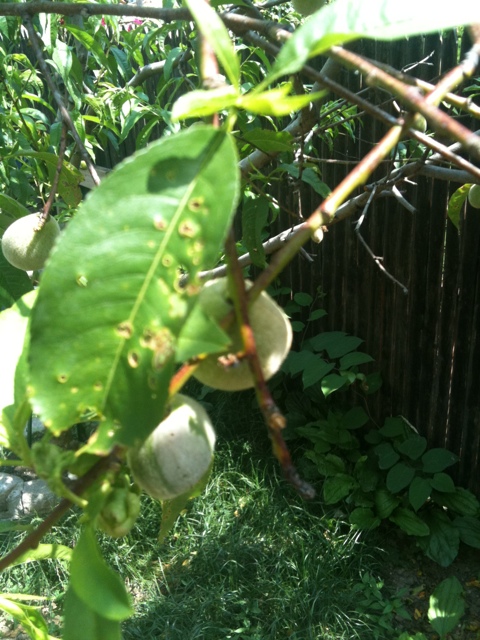
QUESTION: Hi all, just wondering if anyone knows what might be causing these little holes in the leaves of my peach tree? Would this be the work of snails, slugs, or some other little bug? I’ve already been treating the tree with a copper fungicide (not as frequently as the recommended five days but more like every 7-10 days for the last few weeks).  Should I continue?  Should I stop?  Should I do something else?

Ants on my Peonies

NPR did a piece on memories that resonated with me.  It reports that some of earliest childhood memories are basically wiped out, and considers why that may be.  What came to me immediately is that it is because we have no framework at that age in which to “set” our memories.  Everything is new, and mostly stunning.  (I do remember someone saying if you want to imagine what it’s like to be a young child, just imagine that you are visiting a new country everyday, with all new sights, smells and sounds, and some days it’s several countries in a day).

In other words, memories are stronger that have some association or connection, be it with words, emotions, or the general framework in which we view the world and ourselves in relation to it.  Memories set better once a person has a world view; and very young children have no such world view as yet – bless those little free darlin’s!.  Theirs is a world primarily of experience, and only secondarily of the organizing, compartmentalizing, and identifying patterns in and of the experiences they have.  I think it’s essentially the same reason many people have a hard time remembering their dreams: the dream images/subject are not set in a familiar framework from which we can recall them.  They tend to be random, abstract, separated from our everyday framework, yet still connected enough to “reality” that usually they are remembered in bits and pieces.  This may be the same reason that unusual experiences are easily remembered when those experiences occur when we are adults: we remember them as striking for what they are not – they are not are usual, everyday experiences (or part of our regular framework).

All this reminded me of one of my early, among the earliest, childhood memories.  I am standing outside our house, at the side of the house on Newfield Drive (yes, literally, isn’t that so literal?), staring eye to …  I don’t know what – not quite eye – with this ball of pink, tightly wound, … I have a hard time describing it, realizing only now that it’s a visual I have never tried to put into words … I have looked for this flower years later and believe it to be a peony.  Back then, there were a bunch of them at the side of the house.  It was a flower bush, but I watched only one little about-to-burst bulb.  It was swarming with ants, little busy ants.  They were light orange, each going every which way in no clear pattern, no matter how much I tried to find one.  It was fascinating.  I like the feeling even now just to think about it.  I visited that flower a lot.  I know if I were running a full circle around the house, I could stop, and stare at it.  It was right outside my parents’ bedroom.  I felt like it was mine.  Not mine, as in my owning it but mine as in — there for me to see.

I have a vague recollection of flower petals replacing that tightly wound bud where the ants crawled, but it’s vague at best.  Maybe I lost interest then.  Mostly, I remember those ants crawling.  So busy.  Going nowhere in particular.  I liked that a lot.

I also remember inadvertently being locked out in winter and having to use the bushes and my bottom being really cold.

I think I know why I like summer better.

QUESTION: do you remember the first time you came in contact with the earth, recognizing it as separate from you, and perhaps part of something else?  What is your earliest memory?

Do you remember the first time you saw and/or recognized a plant or other flower? Did you garden as a kid?  Did your parents?  Do you remember it?  Did you like it or was it a chore?

Do you know any particular flower that attracts ants like that?  Are they peonies?

Go ahead … gimme the dirt.
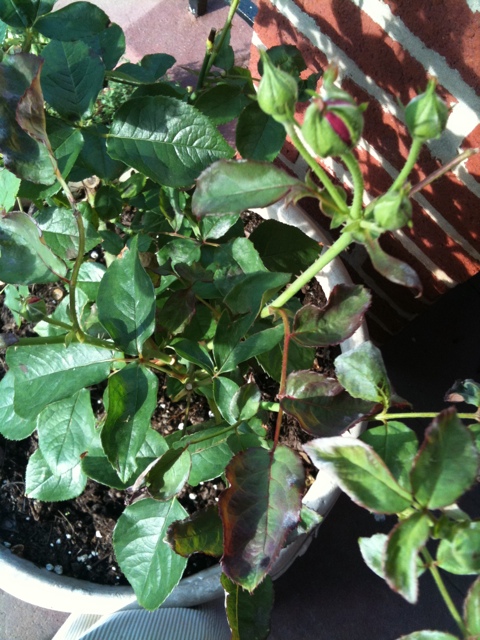
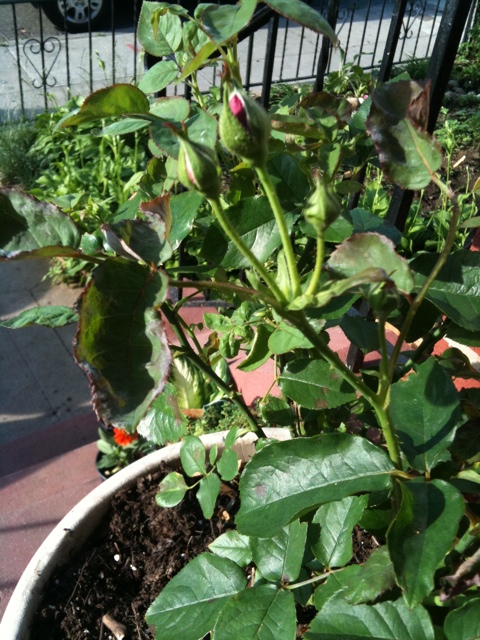
Roses

20110607-074633.jpg

This in contrast is my rosebush of which I’m getting a little concerned because of how some of the leaves are curling slightly and have a little whitish look to them. My mulch neighbor suggested I may be overwatering it, maybe it needs more sun and this might be mildew.

QUESTION: has anyone else witnessed this on their own roses? Is it mildew? Are there treatments other than giving it more sun, less water?

Delicious

20110607-072037.jpg

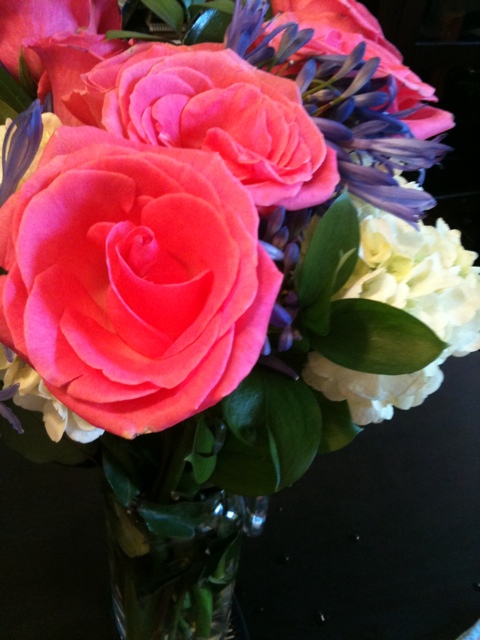
Wanted to start the day with something bright. These are the most luscious smelling flowers ever, courtesy of my lovely buddy, Merrie. Many thanks darlin!

Pondering a London Plane

Today I moved some cucumbers into a homemade self-watering container, and transplanted some baby beets to an apple crate in the front yard, which I notice is getting much more sun than usual these days, thanks, in part, to the London Plane.  I only knew this tree to be the great big one in front of my house, just off to the side.  It, along with a massive pine that came down this past winter, blocked the sun from my front yard enough that I didn’t bother with any significant planting there in prior years.

Today, as my very most awesome neighbor-friend was helping me move my cukes into the container she built for them, I happened to mention that my next-door neighbor has been calling 311 because all the leaves are dropping of the tree so it must be diseased, and should probably be removed.  At that, very most awesome neighbor-friend said she had thought the same thing when she saw all the leaves falling from the yard in front of her building a few blocks away when she used to lived there.  She said she mentioned this to the building owner, only to learn that this is normal for that kind of tree, which is a London Plane who drops her leaves twice a year – once in the summer and again in early fall.  Very most awesome neighbor friend offered me a book to borrow confirming this when I mentioned that next-door neighbor friend was rallying me to call 311 also to take the poor thing down and put it out of its misery.  I was just starting to decline the invitation (I can barely keep up with the reading I’m doing now and knew I would do more than peruse), when next-door neighbor walked by.  She seemed satisfied with this explanation for all the loose leaves in the yard but pointed out that the leaves are all full of tiny holes and so they must still be diseased.   I don’t know if tiny holes in leaves makes a tree “diseased.”  (See QUESTION below).

Very most awesome neighbor-friend told me before the dialogue with next door neighbor friend that the London Plane, since it does shed twice a year, is considered one of the better trees for getting rid of air pollution because it absorbs it, drops the leaves, grows some more leaves, absorbs more crappity-crap, and drops them again.  Hey, nice job, London Plane!

Although a quick perusal of Wikipedia doesn’t confirm what I’ve learned of the double shedding, I did pick up some other little tidbits, including that it tolerates air pollution and root compaction well, and thus is a popular choice for urban streetscapes.  I don’t believe it’s native but, nonetheless, like many New Yorkers, it’s a transplant that’s made its own impact felt: “According to Lois Nam of the New York City Department of Parks and Recreation the symbol of that organisation is a cross between the leaf of the London plane and a maple leaf. It is prominently featured on signs and buildings in public parks across the city. The tree is today on the NYC Parks Department’s list of restricted use trees for street tree planting.”  All of which leads me to my ….

QUESTION #1: what are telltale signs of disease in a tree?  Are London Planes prone to any particular type of disease?  When do you fell a tree due to disease?  Does it have to be deathly ill or will a little sniffle be reason enough to euthanize?  ALSO…

QUESTION #2: what does it mean if a tree is on a NYC Parks’ “list of restricted use trees for street tree planting”?  Does that mean it can’t be used for other things?  What else would you use it for?  Can I not plant it in my backyard?  Why not?  Not, of course, that I’m going to – I have my hands full with trying to confirm whether I’ve got elderberries or dogwood berries back there, but that’s another post for another day.  In the meantime, go ahead … gimme the dirt!

Glad to be Hunter-Gatherer

So the hunting is more about going to Foodtown to pick up some ribs for my partner to smoke (and are they good, and I mean damn good!) but the gathering part I’m also starting to really dig.  Right now I’m borrowing from my very-most-awesome- neighbor-friend the book Edible and Medicinal Plants in Wild (and Not So Wild) Places, by “Wildman” Steve Brill with Evelyn Dean, 1994, and trying to not get the pages too covered with pricey dirt or, earlier today, the really good Sunday Bloody Mary my hunter made for us.

Notwithstanding, I believe I am starting to get closer to the question of whether my three bushes out back (I think I described them incorrectly before as a single bush) are dogwoods or elderberry.  Knowing as you do now that there are three, not one, you can see why this question is ever so pressing, as Brooklyn garden space is premium real estate and I don’t want to waste it with something that might poison the kiddies who frequent the place, or my dog for that matter, nor am I sure I want to leave it if it isn’t behaving usefully, like giving me some tasty berries to make wine or jam, or hiding in its bark the secret cure for hay fever.  Sure, I am getting sold on the idea that native plants are good to have around in their own right and for the simple sake that they are part of an ecosystem that’s been messed with for too long but I’m still not 100% convinced on that matter.  Regardless, I like the thought of eating the stuff in my yard.

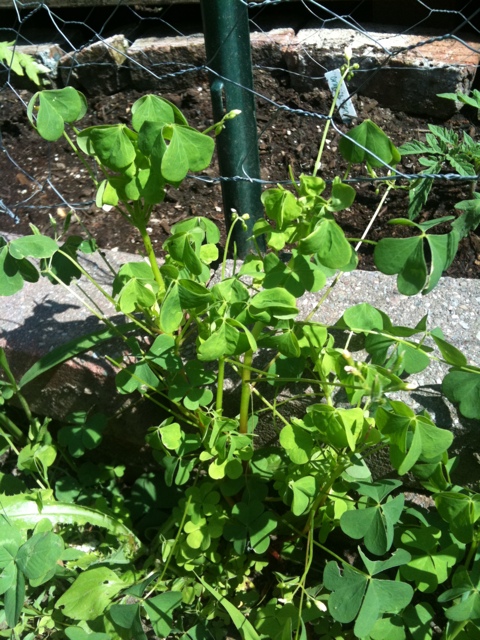
It must be on other people’s minds, too, because I found myself in my backyard Saturday in a group of people, all nibbling on these cute delicate little creatures with soft tangy leaves like clover, all trying to remember the name of this same thing that we knew from when we were kids.  Someone suggested ramps (which was way off as it turns out – I know because a good-old fashioned real-live farmer showed up later and went into how they found ramps behind their property in a swampy wasteland but now folks are flocking for them).  Ultimately, we grabbed the book (thanks neighbor!), and found that they were sorrels.  Yummy ones, too!

I’m definitely interested in eating more stuff in my yard and maybe your yard too.  But before I do, I think it would be responsible of me to get a little more educated on the subject.  Toward that end, I’m thinking about taking a tour with author and forager, “Wildman” Steve Brill, author of the book I’ve been devouring (not literally).  There’s one at Central Park on the 11th and another in our conveniently located Prospect Park on June 18.  Just wondering….

QUESTION: Has any one of you taken a tour with Wildman Steve Brill?  Would you recommend it?  Do you know other people doing these sorts of tours?  Any of you brushing off your gathering skills (it must still be in our DNA somewhere), and foraging for your own fare?  Any words of caution?  Words of wisdom?  Any stories of watching someone keel over after eating what looked like an elderberry but was really from a weird strain of dogwood?  Any anything?  Go ahead … gimme the dirt.

SCREEEEEECH!  STOP THE PRESS!!!  Okay, so I thought it would be nice of me to link y’all to sorrels on Wikipedia and when I did, I saw that they do not AT ALL match the description of what friends and I were dining on in my backyard Saturday.  Someone help me out before I kill us all … I will post a pic tomorrow in daylight and let me know if any of you recognizes it.  In the meantime, for those wanting to know what real sorrels look like, here ya go (then again it is Wikipedia, could be wrong?  Maybe?  http://en.wikipedia.org/wiki/Sorrel).  I also couldn’t find sorels in my handy dandy Edible Plants book, which leads me to another …

UPDATE as of 8/10/11: they were wood sorrels.  Wikipee was showing me a different type of sorrel.

QUESTION: Does anyone out there have any other recommended sources for checking out edibility of wild plants?  Anything more recent, anything forthcoming?  Go ahead … gimme the dirt on this one too.  Oh, and thanks!