MIA: Mourning Jobs

http//ht.ly/6QYwX

I’m glad someone else said it, so I didn’t have to.

After a meeting of the editorial board of Tribes magazine, where executive director Steve Cannon had been stressing the importance of picking what we like and not what we think he likes or someone else would like, I got the news that Steve Jobs died. In a room of six people, I was in the half that was over 25. One of the other half gave the news like he was saying, “coffee’s done.”

News today, in its swift, silent, and soaring reach, gets plunked down in the most unexpected places and ways. It seems the one thing that cannot be calculated by the phenomenal capability of current technology is the precise how and when it happened. This is thanks, in no small part, to Steve Jobs. And the news of his death was delivered in the most appropriate mode: a room where no phone rang, no television was on, no radio was being listened to. No one walked in the door. But suddenly, everyone in the room knew.

I am trying now to remember the last big piece of bad news that might be my generation’s Kennedy moment — a flashbulb memory” of our time. Although I, of course, remember where I was on 9/11 (I was, as they now say, “there” on 9/11, so that doesn’t count since it would be like being in the crowd at Dealey Plaza when Kennedy was shot, and my flashbulb memory would be more of a stadium lights memory). I remember where I was when I got the news that Michael Jackson died. It was a few summers ago. I remember I got off the phone with A (my oldest daughter who was in Minnesota at the time and, since she led with the news, I thought it was some kind of a joke – you know, “Hey, Mom, did you hear Michael Jackson died?” – a pause – “No,” I said, anticipating the punchline, but there was no ba-da-da to follow). After hanging up with A, who had no more details than that he was dead, I turned and told Karen the news. “Oh, yeah, I know. Can you believe it?” We watched the TV coverage, finished our drinks at the Edge, and headed back to Brooklyn to see what was being said on the more reliable pages of our Facebook friends. When John Lennon died, I was too young to form a clear memory of the moment. What I don’t remember about that time, or after, is people talking about it the same way they exchanged stories of where they were when they got the news Kennedy was shot. Oddly, what I remember about the day Elvis died was hearing that some woman was so upset upon hearing the news that she got into a car accident and died. I don’t have a flashbulb memory at all of the Challenger. I watched it fall apart in the sky, on the TV screen, as we sat gathered in Miss Knipschild’s Home Ec class at Parkview High School in Orfordville, WI, with the lights off and the TV on to watch the historical event. But now I’m not even sure of that, since there’s no flashbulb action to that memory — just having a vague sense as I watched it that “well, that was kinda weird,” and, “hm, that couldn’t be good,” but I don’t really remember the magnitude of it registering, not the way it did when I watched the first tower fall and thought to myself or maybe said out loud, “Oh my God. There are people in there.” The lights got turned back on. I think the TV was turned off, and she went out in the hall, while the students sat stunned, not knowing what to say. A few days later, the whole school had a moment of silence like we had many Christmases earlier when my politically savvy Uncle Eddie, a cabbie from Chicago, came for a visit and we stood outside under a starry sky before a vast field of moon-reflecting snow and shared a moment of silence with the rest of the world for the hostages in Iran. Although Jobs’ death probably will not be my generation’s flashbulb memory, the impact was felt far and wide. Evidence of his ability to inspire was all over Facebook and old media alike. And I think I’ll remember it, if for no other reason, than it bore witness to the impact of his work.

Steve Cannon, now 77 and an icon of New York City’s literary underground, black since birth and blind since the ’90s asked one of the younger crew what he thought about Jobs. The young black man was painting the wall white. He worked on one wall, while a white woman his age painted the wall on the other side of the room. I sat between the two of them, with the rest of the over-thirty crowd. I think the conversation got twisted and now we were now talking about Jon Stewart or Stephen Colbert, and Steve was demanding to know in his amusing but annoyingly persistent way, whether the young man thought he was funny. The young man was saying he didn’t watch TV. Steve was asking what this person mattered then if no one was watching him. I said that I watch them both and think they’re funny, but tried explaining to Steve that kids don’t really watch TV. I then had to explain to the ones in the room who didn’t know that I have a 21-year old daughter, and that she doesn’t really watch TV- she just watches whatever she wants to see online. The young woman, who was painting walls for the upcoming photography show, said that her hippy liberal parents watch TV but that she doesn’t. But they love him, and she loves them. So there’s my flashbulb memory of the death of Steve Jobs — trying to explain why, if Jon Stewart is funny, the kids don’t watch him on TV but I do.

The night that the news of Steve Jobs’ death broke, my husband was at home with our 18-month old daughter, who we have frequently observed already being adept at using my iPhone and who will be witness to unimaginable technological advances, and who, for now, was fast asleep. He texted me, “A little sad Steve Jobs dies. Innovators inspire.” The soft tone surprised me. He works in computers, programming large displays for a living, and seems to take the most earth-shattering news in unbelievable stride. I spoke to my older daughter, A, a few days later. I’ve watched in bemused amazement as she has breathlessly waited the latest iPhone upgrades and has tracked online, with OCD attention, the shipping of her latest gadget and has had me drive her to the Apple store in midtown many a late night. I said, “Hey, Steve Jobs died this week. I’m sorry.” She bust up laughing, then yelled into the next room to tell her roommate what I had said. She pointed out that she didn’t know him personally. I was surprised that my husband, who doesn’t usually display a sentimental side, seemed more affected by the news than my older daughter, whose world had been so shaped by this man at the helm of Apple. Then it occurred to me that her world, indeed, had been so shaped by him that she had the luxury of taking it all for granted. I recalled when I was 7, and my father worked for Parker Pen in Janesville, and he used to take us into the “computer room,” where you could hear the humming and whirring of the computer which stretched all the way around the room and in its center, and churned loudly, processing massive data. When he would drop us back at home, my sister and I would take the punch cards used to feed the computer and run them through our make-believe high-tech cash registers as we played house. That was 1978.

I wonder what our flashbulb memories here forward will look like. Will they consist of a person, alone in a room, reaching in his pocket and pulling out his phone, glancing at it for barely a second, then putting it back in his pocket, and sitting silently for a moment, aware of the thunderous news reaching all round the globe? The smoke signals and Morse code and megaphones and speakers and broadcasters and news anchors and Paul Revere and the newspaper delivery boys and the barkers and the deejays and all those other rusted out modes of communication will have given way to the single, solitary person, alone in his single, solitary room, not bothering to gasp because there’s no one to hear him.

I gasped. It’s like I completely forgot that Steve Jobs was battling pancreatic cancer for the past seven years. With his regular appearances and apparently enough money or good fortune or fortitude and determination, he looked thin but not bad before the cameras. It appears that until the end he fearlessly led. He made it easy to forget. Just a day before his death, the public was grumbling about the meagerness of Apple’s announcement of iPhone’s latest upgrade – not an iPhone 5 or even an iPhone 4gS (as the latest email scam has been selecting me to test), but just a measly iPhone 4S. The public’s dissatisfaction with an impressive but not stunning upgrade is explained only by the groundbreaking expectations Jobs’ company set. Had he only set the expectations as high for his company’s social responsibility as the quality and innovation of its products, he’d have left a legacy that would be worthy of his ingenuity. I know some of you may be saying that his company’s failure to use its status to bring more jobs to the States or bring attention to issues surrounding corporate responsibility cannot take away from Jobs’ legacy. While this may be true, given that technology is moving at a pace so dizzying, even technology itself seems unable to analyze its own reach, my guess is that the technological gains made in the past forty years will seem like baby steps compared to what lies ahead in just the next five to ten years. Our reverence for these baby steps will likely be found amusing by the next generations, who are born taking that pace of advancement for granted.

As it’s been said before, none of this will mean much if that technology isn’t aimed to the greater good of our survival. That man sitting in that room getting that news that’s being spread around the globe in a heartbeat, may be alone in that room not out of choice or as a result of the dystopic isolation endemic to hyper-consumption of electronic media but maybe because the ants won, the scientists were right, the politicians were too busy fighting with each other to care, the protesters got tired and went home, and even if Al Gore had gotten the presidency he won, the last three years have shown us that it probably wouldn’t have made a difference anyway.

This time feels very “now” but soon it will be past. How will we remember it then? As the turning point, after which it all fell irrreparably apart, and nothing was ever the same again (and not in a good way), or the point at which people really woke up and realized we had to act, and fast, and did.

I Know Who Poo’d – Part III – the Final Act (?)

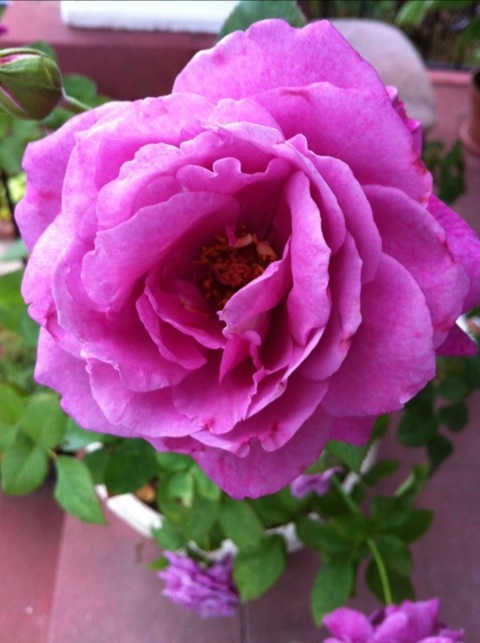
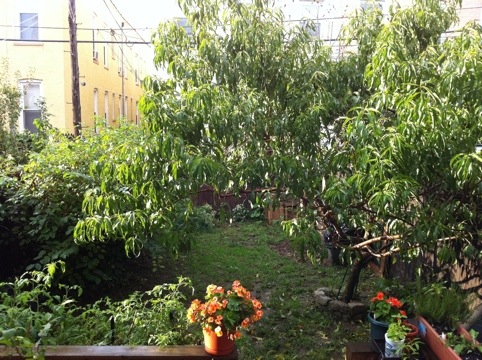
All bets are off.  All neighbors redeemed.  I caught someone photographing flowers in my front yard today.  It made me happy to make someone else so, and decided that is that, and to let all the rest go.  (although I will be taking Ralph up on some of his suggestions, echoed by my partner as well … no harm in dissuading future pooing, and thereby encourage harmony in the hood).

CSA Still in Swing

On the friendliness factor, this was one of the better visits (keeping in mind my expectations are significantly lowered based on previous visits). So the experience of going to get my produce was a pleasant one, overall.  As before, there were no tables for the produce.  The veggies and other goodies were, instead, in crates on the ground.  I don’t mind this.  It makes it easier to see what you’re getting. It’s also lighter, more open, airier.

Per usual, the allotted amounts were a little scrimpy (4 leaves of collard greens? Really?? Just four?).  The variety, however, was peak.  I’ve wondered before if they go out and buy items from other places when they’re running low and, if so, from where.  They had peaches very early, when it just didn’t seem possible to have peaches.  Their flower selections are wrapped and packaged in a way that just doesn’t look like it came straight from the farm (wrapped in cellophane with handles like the often sad-looking hyper-colored bouquets at Church Avenue mini-grocery stores and LES bodegas).  On occasion, there will be a food item or two that simply looks like it was a stray, along for the ride and to round out the selection.  I don’t mind, I guess.  We benefit.  I’d rather like to know, though, where each item is from, and I haven’t always gotten a clear answer when I’ve inquired about some of these (suspected) strays.

As for the goods, we got green beans, slim sweet green peppers (just two but oh well), a bunch of lovely radishes, 1/2 lb. beets (which equaled two smallish beets), one head lettuce, two sweet potatoes, my four collard greens, five apples (that’s generous), six pears (also generoso), a bouquet of flowers and my usual six eggs. Oh, and kohlrabi and one other squash like plant I forget the name of and do not recognize. Close up to follow. For now, here’s my stash ….

mind my expectations are significantly lowered by my previous visits). So the experience of going to get my new produce groceries was a pleasant one. Sometimes folks sry put bo

20110929-045252.jpg

Totally Unnecessary Kitchen Science Experiment

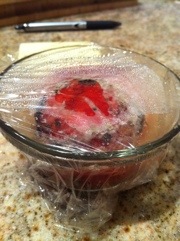
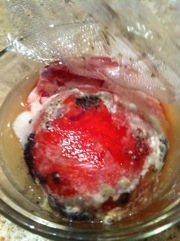
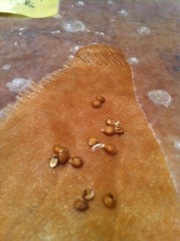
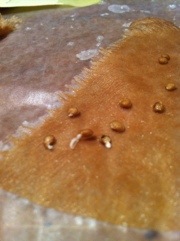
Here’s a whole tomato that had sat on the vine a little long. I plopped it in a ramekin and covered it with plastic wrap, fully intending to get it labeled and into a uniform baby food/seed saving jar with proper cover and label.
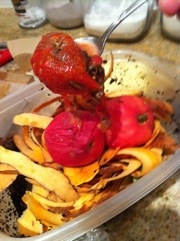
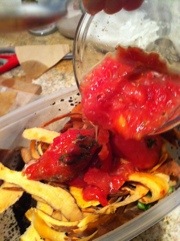
I didn’t get that far, but I think the mold and tomato may have done the work on their own, nature’s way. Time to harvest!

20110928-012714.jpg

20110928-012725.jpg

I Know Who Poo’d

All summer I was extolling the virtue of neighbors and knowing them, then something dropped me in my tracks last week.  It was a little pile of poo, neatly secreted through the a-hole of a very small dog, two of them in fact (turds and dogs).  The dogs, I could discern from the droppings, were the little yippy kind.  Only those kinds of dogs can squeeze out those baubulous bobbles of doo – the round, hard barely-a-fist-size kind.  Only an annoying, overly-trimmed, tailored, and parlored kind of a canine can squeak out those equally offensive rocks.  Not that I have anything against the dogs.  I do not.  It’s the owners who insist that just because a dog is of a certain size, dimension, and coat hair, it must be coddled, curled, and coiled up in travel baskets and squeezed into pastel duds that are even saccharine on a doll.

I have to pause to admit that I did not actually catch the canine culprits in action, but in light of surrounding circumstances, I can be pretty certain I know who they are or, at least, who their owner is.  She’s a neighbor, but not an acquaintance or a friend.  She was blathering away in a high-volume pipsqueaky kind of a voice very late at night a month or so ago, dead center of the sidewalk in front of my house.  The words she was using did not match her manner of dress although I may be elaborating here.  It seems she was cursing like a sailor.  Or maybe it was the content of her call.  I recall that there was something offensive enough about the occasion that it prompted me to take the rare step of using a stage whisper through the window to suggest she “move on.”   Personally, I thought it was a nice way to say what she really deserved to hear.

This block is a quiet one.  It’s a one-way.  There are old people.  There are babies.  There are people with early-morning jobs.  There are blue collars.  There are white collars.  And no one seems to know for sure or care at all which is each.  There are new couples with babies.  There are more than a few little old ladies.  There are, I believe, even artists, but they’re the solitary kind that are up at night working, not up all hours talking about being artists.  Or they’re the kind (like the one kitty-corner to me) who sleep at night to get up early and take their dogs on a non-poop littered walk so they can come home and give lessons to musicians (who aren’t as good as them but are getting better) so they can continue to be artists and musicians.  (I, like others in this little stretch of row houses on my street, view these mini, on-going serenades of lessons as a fringe benefit to being on the block.)  There are people who, if they need to have a lovers’ quarrel or family feud through the air waves, and can’t do so in the privacy of their own homes, will at least move on when someone makes their presence known, “ahems,” or kindly, as I did, suggest they move on.  That night, the little chickadee in the Juicy Couture velour with her matching miniature whozseedoggywhatzsits, took offense at my suggestion.  She said something utterly forgettable about it being a free country or me not owning her or the sidewalk or some such other nonsense that indicated she has no regard for making the world a better place through love, kindness, and peaceful harmony.

The first summer I lived in this house, in the year 2000, I had some friends from Wisconsin who came to visit.  I don’t remember if it was a weeknight or a Friday night.  Either way, it was late.  We’d been drinking.  We’d been laughing.  We were on a back porch in Brooklyn.  We were free.  The night was ours.  So we thought, until my next door neighbor, who works the graveyard shift, stuck his head out the window and barked at us to “Keep it down out there.”  I wanted to crawl into the ground.  It froze me.  My friends all started cracking up over it, and eventually I did too.  They took that moment and froze it in time.  They still pull it out to polish it with retelling.  It was their first true New York moment.

I put on my neighbor’s voice to put this pipsqueak in her place.  “MOVE ON!”  She was still yakking away when I went to put a collar on my good sized dog.  She may be advancing in age, but she’s still more than twice the size of Juicy’s little rag dolls that were prancing near my front stoop.  I don’t remember if I had to bring out the big dog, or if the silence of the night made her realize her words were falling loudly, and she might be outnumbered in the people who, in this moment,valued quiet over freedom.  I still hadn’t said more than my two words repeated once.  (I’ve been here long enough to know that on my block, like many, past a certain hour, it is best to do what can be done in few words).  Within minutes the encounter was over.

So I thought that was the end of it.  I’ve seen her since then.  We have a silent pact that requires neither of us to look at the other.  Nor are we required to extend the usual dog-walking courtesy of crossing the street if there’s any chance of an unpleasant interaction.  We stay the path, bothering only to keep our dogs under tight rein.  And I thought that was the way it was and the way it would be, and also the end of it.

But last week, I came home to poo on my pavement.  Smack dab dead center.  Unmistakably in front of my house.  I started to tell my good neighbor/friend about it.  She lives on the same end of the block as Juicy.  My good neighbor/friend lives right next to Juicy’s apartment building with her two kids and partner.  They’re out there so often, and soak in so much about the neighborhood,  I’ve decided her partner’s the mayor.  So in my retelling of what had happened, before I could get to the second “move on,” my friend was finishing the story for me.  Turns out Juicy told the Mayor what happened.  Next thing I knew, my friend/neighbor was telling me the rest of the story, with Juicy defending the fact that it’s a free country, and all she was doing was talking on her cell phone, and it wasn’t even really that late.  And she doesn’t even really know them.  So my suspicions were confirmed.  She trained her dogs to poop on my path.

Now before you go thinking I’m jumping the gun on this conclusion, note that I have seen her since our initial encounter, loiter with her dogs in front of my house, looking around to see if anyone’s watching.  A passerby always seems to appear before they get to doing their doo.  The sidewalk, too, by the way, is a free and clear canvas.  There are no hydrants, or flowerbeds to awaken the little doggies’ urges.  Moreover, most people pick up their dog’s dookey, so much so that even a “curb your dog” sign on the block is rare.

So I was mulling all this over in my head tonight, as I took my dog out for a walk after being away all weekend.  I have known my dog for a good seven years.  She has never, in all the time that I’ve known her, ever pooped on the sidewalk.  She has always had a yard at her (and for her) personal disposal.  With only minutes to go till we turned the corner onto my block, she pulls over and squats deeper than is her custom.  A few feet ahead of me, a delivery guy was getting on his bike.  He was watching to see if we would cross first or if he should go ahead.  In that moment was when my normally uber-private puppy got into that unmistakable crouch, nearly in the middle of the sidewalk.  Of course having walked her without ever needing a bag, I was empty-handed save for her leash in my quickly tightening grip.

I didn’t have time to see whether she left a gift, but I think it was at least a token.  I whisked her away hoping that whoever’s house it was doesn’t have a neighbor with a real, or perceived, vendetta.