Cukes! These are from the homemade self watering containers.
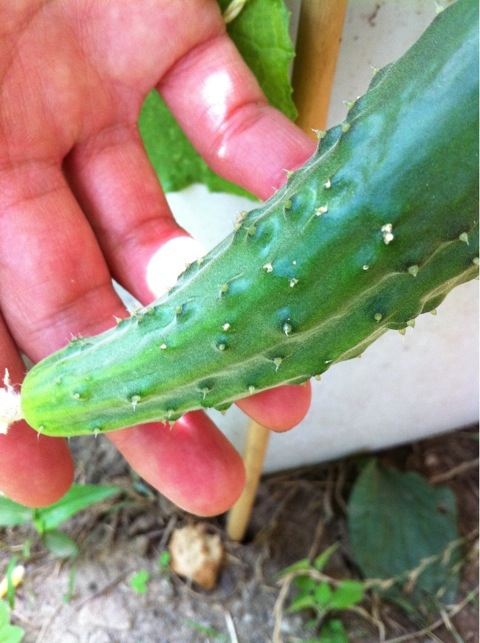
Cukes! These are from the homemade self watering containers.
I’m emptying my basement of everything in it. I figured it was getting to be a fairly expensive storage space, given what rents go for today. I hate that there is so much I’m throwing away but I also recognize that to repurpose, reuse, sell, or even donate all the items I no longer need would require additional time that I’d really rather spend doing other things – like gardening.
Although I may freecycle a few items (I’ve used it before for other things I let go of, and was fairly happy with its usability). I clutterbust somewhat regularly though. It’s a healthy purging, I find. Inevitably good things (note, not “stuff”) come from it. So usually I just set as much out in front of my house as I can, without using any space on the sidewalk. This can get tricky because there’s not a lot of excess real estate in Brooklyn, even down to front gate space. That’s why I love things I can hang on the fence, like hangers! At about midnight, I put a small store’s supply of various plastic and wooden hangers, no wire ones (yes, mommy dearest), and within minutes a neighbor appeared out of nowhere. As we started talking, she collected up the plastic hangers, stringing them across her arm. As it turns out, she is married to a gentleman down the street who has been very encouraging about my little garden plot, stopping by every so often to ask and admire. I’ve loaned him a wonderful little crazy rake I have that tills the ground in no time. Once again, I found myself talking with someone who I have lived near for more than ten years and had never met before. I hate to say this but I honestly don’t even remember seeing her before — I feel like I’ve been wearing blinders for a very long time now. Gardening is showing me that good things happen when you just put a little effort into it.
There is no question in my mind, as I sit here sweaty and spent, that gardening and all that goes with it is absolutely like raking through the things in life – concrete and otherwise – that bog you down. This has been a difficult process because my mind was trained to think I “need” more than I do. It is helpful though, too, as I’m thinking about what more I want to do (and, more importantly, not do) with my garden for the remainder of the summer, and am also feeling grateful that once this is done it will be one less thing to pull me away from my gardening.
QUESTION: Do you have to give something else up to make space for something new? Will you be adding or subtracting anything from your garden this season?
I had asked, if I had just one plant left to plant, what should it be and why. An answer I received was borage. Forage for borage? I like the idea. Here’s the comment, and why I will probably take the suggestion and plant with it…you can put it in a salad. And it sounds a little different from your standard garden fare. I think I will be planting this weekend, but I’m not sure whether I’m going to plant from seed or a small plant. I’ve been wondering about the question at the end, as well, and what to hear from other folks whether you’re tending more toward plants or seeds.
Here’s Ralph’s comment…
Maybe take a look at Borage. An edible herb I use in salads- something of a cucumber taste. Small leaves are best since they are ‘hairy’ and it gets more like thin bristles on large leaves. They make small blue flowers which the bees seem to love- the reason I got it. They produce lots of seeds about 1/16 inch long so they’re easy to collect, or just let them fall as they may. Last year mine got about 2 feet tall, and they seem to grow pretty fast from seeds.
Check out red clover too. Another medicinal herb and it’s great for building up your soil. I put these in salad too and have it growing in the ‘wilds’ of my yard. While researching it a while back Sloan Kettering came up on Google. After accepting their disclaimer they had a section on herbs. Red clover was there and it said there is some evidence of it’s fighting cancer, but more research is needed. Gee, that’s one of the things herbalists use it for. What a coincidence.
I downloaded a free PDF of a 600+ page book out of copyright that’s about using various herbs medicinally. It’s from the 1880s if I recall. I wouldn’t use it (or anything else) without confirming what it says, but it is full of information on identifying and preparing herbs. If anyone is interested I’ll try to find a link to it.
[Here’s Ralph’s question …]
How is everyone starting their plants? I use almost exclusively seeds, my niece has great luck buying small plants. What’s your preference, why?
[Here’s my follow- up…
QUESTION: anyone else have any experience with borage? I’ve been doing a combination of seeds and plants. I was surprised that both beets and carrots sprouted up from seeds this year, as did my pumpkins, and they’re really taking over. I have to start thinking more seriously about seeds though. I do tend to keep the ones I don’t use over the winter in my basement. I also take seeds from the plants I grow and try them again the next year but haven’t had much luck with that, including some really beautiful pepper plants (cayenne, habanero and jalapeno) that I had last year, whose seeds gave me pretty much nuthin this season. Maybe I’m doing something wrong? Go ahead .. gimme the dirt!
Ah, New York, my sweet. What’s not to love?
My partner started making ice cream this summer (poor me, right?). The first stash from the CSA had some lovely lavender that constituted the flowers portion of our pick up. All I had to do was stick it in the fridge instead of a vase, and the next thing I knew, voila, dessert! This last visit to the CSA landed me some gorgeous deep purple blueberries now in the icebox waiting for the fairy dairymother to whisk them away. So many reason to love New York this week.
But with some good news comes some bad. Heard in the media-stream this week is that grocery stores are pushing back on consumers’ increased use of coupons with greater restrictions on coupon use. The whole CSA experience, while a wonderful experience, may still not be the best value for folks looking to disrupt their regular food sourcing. I’m still wanting to do a comparison of the options, from the traditional grocery store to home gardens to farmers markets and foraging. While I can understand a company’s need to plug the bucket, so to speak, now might not be the best time to kick the consumer where it counts, considering that our flirtation with alternasourcing seems to be deepening into a more serious relationship. Grocery stores may have even more competition ahead from innovations to their traditional model by store owners starting to think outside the box (Austin is expected to have the first packaging-free grocery store in the near future).
As for me, I will continue to report on my CSA experience, and hope that someone takes me up on my invitation to compare theirs (looking for someone signed up in the City with a different CSA, and someone from outside NY – maybe one of my Madison friends?). (I am doing the full half-share, which means I pick up a full share – vegetables, fruit, eggs, flowers – every other week @ $550 for 24 weeks, which works out to be about $45.00 every pick-up, but would like to do a comparison with anyone doing a CSA this summer, regardless of what you’re signed up for). I’m also looking to hear more on another …
QUESTION: how have your food collection and sourcing habits changed? What percentage of your meals comes from sources other than the traditional grocery store? Are you getting any staples from your garden? Of the home gardeners, do many of you can to make your stash last after the season’s over? How many of you are keeping the garden going indoors over the winter? What have you got growing indoors after season? Anyone else out there who’s getting their groceries outside the box? Of those who forage, would you say that you’ve incorporated the wild edibles onto your every day plate? With apologies to any skin-thinned freegans, have we got any garbage eaters out there? Any other urban foraging? Anything I’m leaving out? Go ahead … gimme the dirt!
This discussion of weeds: is there really such a thing? has generated a touch of interest and a tad of controversy, so I think we should stay on the weed, for now, so to speak. In this post, I look at what constitutes a weed. As in the words of one famous reveler, “A weed by any other name would smell as sweet.” Another fellow reveler put it better when he said, in relevant part (the rest is good too, check it out in the full comment appearing earlier today):
I recently listened to a podcast where someone said ‘a weed is an herb growing in the wrong place’. It still makes sense if you broaden the term herb to plant. Although I never thought of it, weeds serve to help the garden. Weeds are often some of the first flowers to appear in the garden and attract bees and other beneficial insects. Check out http://www.theselfsufficientgardener.com and listen to the episode on weeds. It gave me a whole new outlook on weeds, and gave my garden a different look- especially the part that now grows wild. Once I did go walking through the wild section with a machete. It’s not that it is that wild, I just needed to cut the tall grass seeds and get rid of them without damaging the red clover growing below. The lawn mower would have cut everything. … I hate to kill plants, especially if I planted them. (Thanks Ralph!)
As I mentioned, my mother is here visiting from Wisconsin. She has been preparing, for quite a long time now, for one massive blow-out rummage sale in Beloit in August. My mom seems to be a magnet for things: she knows antiques, books, history, dishes, furniture, philosophy, literature, music, records, record players, and this and so much more. She seems to be able to find something to appreciate in nearly every person and every thing. For that reason, she has amassed quite a collection of oddball items and exquisite finds. And it is all good stuff. It’s just that it’s still, well, stuff. She has recognized the need to let go of it, and saying good-bye to all of it, properly, has turned out to be quite an undertaking. She has undertaken to meticulously wash, inspect, iron, shine and spiff every little thing and every little thing on every little thing. My dad has suggested the process is ravaging her, and she needs to just let go of it. Which is exactly what she is doing. She, I believe, in this ritual preparation is saying good-bye to these things of hers which have become weeds.
For a year or more, I went through a process of letting go of decades of collected stuff. The task was to big for me on my own. I had a professional clutter buster who helped me see that the only way to make room for new and better things in your life is to let go of the clutter, which is, basically, anything that’s not useful anymore. So over the course of that year, I undertook multiple clutter busting sessions. The process changed my life. I happened upon his blog today, and found this very apt description of his of clutter busting:
It’s common that clients are surprised at how much stuff they actually have. As the clutter bust proceeds, more and more stuff is found hidden in drawers, closets, under the bed, in boxes, underneath things and in piles. It’s like the clown car at the circus, twenty clowns end up coming out of a tiny car.
We get anesthetized by our clutter and we lose touch. Our awareness is dulled. In the same way vision can get hazy, awareness gets out of focus. We get used to the blur and it becomes normal for us.
That’s why I’m kindly relentless with encouragement to dig deeper into your stuff. There’s hidden stuff silently wrecking your life.
see today’s post (June 27, 2011) on Brooks Palmer’s blog: http://brooks-palmer.blogspot.com/
I think if there’s room left for the word “weed,” to me it would be defined as clutter in the garden.
I may do it. I may try to tame that part of the yard. I’m not sure if that wild part of my yard is a nod to my own rebellious side, or if I just got exhausted plotting and planting the front half of the yard, and let the rest of it rest. I will probably do something in the back half. I’ll probably put my mom to work on it too. Who knows what we’ll discover there. It takes a very special dynamic to garden with another person. Maybe instead we’ll just kick back with some beer and cheese, and watch the grass grow.
QUESTION: What in your life, or garden, or garden of life needs weeding? Is there anything in your garden that has lost its usefulness to you? What other plant or thing might arrive when you make room for it? Go ahead … gimme the dirt!
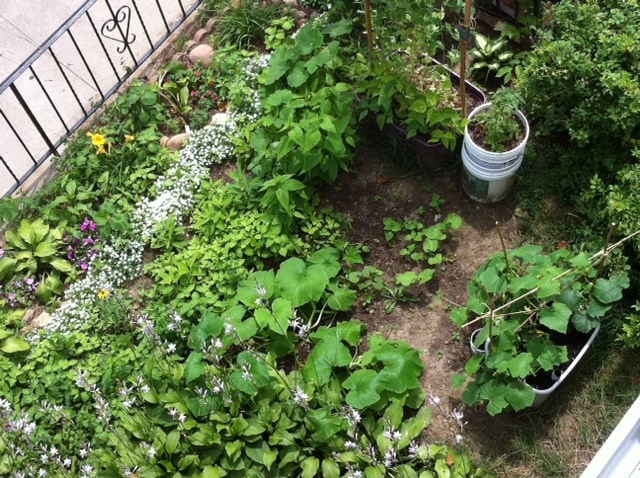
Here she is as of this sunny Sunday morning. Aside from the pumpkins stretching out and taking more real estate than I’d anticipated (they’re to the right of the hostas, having been transplanted from the upper corner of the garden where two remain), they all seem pretty happy together. Lining the front fence are my hostas which I thinned from the side. You can see the border of hostas now on the bottom of the picture. They’re in bloom, with some tall pretty stand-up flowers that look like they’ve reached up to admire the rest of the garden. As I mentioned before, these are the oldest plants in the yard. A neighbor who still lives across the street from me gave them to me when I first moved in more than ten years ago. They have survived bitter winters, and more than one invasive procedure to fix a main pipe running from my basement to the street. I thinned them out early in the season because they just really look like they wanted to move. So I put some of them up front. You can see one just to the left of the yellow day lily, which my sister brought from Wisconsin. The small wall of white flowers that border the hostas and day lilies (which, I’ve just learned in picking the link are so called because each flower lasts only a day, making even more poignant the fact that the first one appeared on the summer solstice – what sage plants have I!). have a name I can’t remember right now. Behind them is my little native plant garden, which has ironweed, some others, and the lone yellow black-eyed susan poking out toward the left of the pic. Surrounding the various native plants are the small ones that are actually Johnny jump ups scattered from seed I planted off to the side but which attracted birds, who gave them a new home. At least this is what I suspect they are. Several people have asked me if I’m going to pull them out, assuming they’re weeds because they were so much smaller than the native plants I put in from small plants (not seeds). I’m hoping they bloom brilliantly, though they might not till next year. (Note, in grabbing the hyperlink for the johnny jump-ups, I thrilled to learn that they are edible!!! I just love pretty eatable things.) Still closer to the house are the pumpkins from the CT restaurant I mentioned in an earlier post, along with the wild ginger from Saratoga Springs, and the couple of container plants – one that my super-neighbor-friend from down the block has for sweetpeas and green beans that are much taller than we anticipated and my own cukes in their own self-watering container (these are where u see the yellow flowers – and also in the other planter box to compare whether the sel-watering type fares better). The rest of the yard closest to the house – which is barely visible from this pic b/c it’s cut off there – is pretty much wild, for whatever that means anymore. I do think I have a tall weed/plant taking over, and have been trying to weigh its usefulness. I spotted what I thought was the same plant on the Wildman tour of Prospect Park recently, and when I asked our guide, he said it was goldenrod. I probably won’t mess with it this year but already thinking ahead to next spring. With that in mind, here’s my …
QUESTION: what is the point of goldenrod? Is there really any objective, verifiable difference between a weed and a plant? Is it really just in the eye of the beholder? Assuming this is a native plant, how does it help the greater ecosystem if it’s just taking up a little spot in my front yard? If I decide to keep the goldenrod, assuming that’s what it is, how would a native plant activist feel about me moving it out of the way? Does that disturb the whole notion that we should just leave native plants well enough alone, wherever they happen to reside? Would moving it be better than pulling it out and feeding it to my compost bin? Would doing so, in the eyes of the nativist, be a sin? Help me out here. I don’t mean to disturb the universe. So, go ahead … gimme the dirt!
So yesterday’s question was what I should plant, assuming I only have it in me to do one more this year.
Strawberries seems to be leading the pack (the only answer, btw, where are the other revelers – come back in from the garden and let us hear from you). Okay, so I did try strawberries in a container last year in a bit of shade. They got sun starved (I assumed, anyway) and their weak little stems and leaves pretty much just shriveled up and died (very similar to what my ivy is looking like on the upstairs terrace but I’m thinking maybe that’s the multiverse telling me there are better ways to find shade and privacy, and I should try instead just to love my neighbors not hide from them, and maybe a wall of ivy would block their sun and be a bug haven). Ivy aside, I would LOVE to have some cute little strawberries to throw in a summer salad, so I think I’m gonna take Ralph’s suggestion and try, try again.
I checked in my handy dandy guide to gardening – “How to Grow Practically Everything” by Zia Allaway and Lia Leendertz (what great surnames for garden book authors) – and it makes no mention of strawberries being sunhogs. It does recommend using slow-release granular fertilizer for container planting strawberries, though. This gave me pause because I’ve generally shied away from the stuff since I don’t trust it – not with good reason necessarily. I typically put together my own soil mixture in a large paint bucket, comprised primarily of the $5.00/bag organic Hamptons Estate topsoil (whose price tag I’ve prematurely bitched about), PLUS a few large handfuls of no frills mulch, PLUS a few quarts of homemade compost (this batch is peepee free – I’m still cooking the human nitrogenized stuff), PLUS a few cups of peat moss if I have it, and/or a handful of Perlite.
Out of curiosity today, I tested my hodgepodge soil using a store bought kit, the “Rapitest.” It’s a truly awful name, I know. I felt like I was on CSI, Hard Core Unit. It set me back about 6 bucks, give or take, at my local gardening store, and has the capacity for about ten tests. The Rapitest told me that the batch I composed (which is pretty typical of what I usually put in my containers) was around a pH 6.5, “slightly acid.” I was satisfied with that, and didn’t mess with it any further. I consulted “How to Grow Practically Everything,” to find out whether I’d get a gold star for my person-made dirt composite but was disappointed to find that all they really say about soil is to know the pH, but not what to do about it once you find out, which, of course, leads me to my
QUESTION: How do you know what a good pH level is generally? Does it really depend on the plant? On where you’re growing? Do other gardeners mess with their soil to try to get it right? Or do they just jump in, pH be damned? How many of you pshaw with the pH testing as all a lot of fussiness? Is it a damper on the revel spirit to engage in fretting over soil composition? Or is a soil’s pH the necessary foundation for a garden? Do any of you swear by testing? Do any of you just go by feel? If you’ve changed course and either ditched or adopted a soil ethic, tell me your story. Go ahead … gimme the dirt!
Three Things I’ve Learned I Can Live Without and The Earth Is Better For It:
– my car
– foreign fruit
– blood diamonds
Three Things My Descendants Will Just Have To Hate Me For:
– flushing too much
– my Post-its addiction
– my Kindle resistance
Three Things I Think I Do Right That Probably Just Fucks Things Up
– buying and using Foodtown reusable bags made of polpropylene
– blogging
It’s the kind of day that makes you give up on things. So many to-dos that I to-didn’t. Like staking my cuke containers and the tomatoes out back. Or setting my crowded beets free and giving my carrots some room to grow. I got halfway to planting a mysterious squash that had appeared unexpectedly among my container sage – and only this by putting my neighbor friend’s kids to work (while we kicked back with coffee & tarts – this is, after all, what parenting is about, right?). And, on the advice of a very sage fellow reveler, I finally decided I am NOT going to use those Triscuit card seeds. They kinda freak me out. Does anyone else think that there is probably something a tad toxic in the gum that holds the cardboard seed card together? And hasn’t Nabisco confused most its constituents who think someone stole the seed card since it looks just like part of their cracker box?
Yes, it was that kind of day: hot, humid, with too much something in the air, making hay fever go haywire, making a person delirious, and not in the good Prince circa 1983 kind of a way.
There is the good. I learned that the City is providing seeds and something else I imagine for garden growing in the projects, but only the old folks are doing it. There is the bad. There was an armed mugging just a couple blocks down from me in regular daylight (wasn’t broad but it was only 9 pm). Then there is the ugly.
Like the duck. This was the kind of day that makes me want to choke the duck. There is a toy that found its way to my house within the past year. It is a grubby-looking matted hair whitish-grayish looking duck that my dog sometimes loves and sometimes ignores. And when you squeeze that duck at just one particularly hard to find spot on its creepy arm-like wing, it sometimes rolls its head and sings, “It ain’t gonna rain no more no more, it ain’t gonna rain no more,,,how in the heck can I wash my neck when it ain’t gonna rain no more?” The duck seems to move itself. I put it one place, I find it in another (and this is on days when my dog is being lazy and secluding herself on the cool comfort of the basement floor). I heard it on level balance that even farmers lately are weirded out by the non-weather “weather” we’ve been having — that they think it’s gonna rain then it doesn’t. That all signs say go – the animals doing their little scatter or whatever it is dance, the leaves turning upside down, then nothing. Not a drop. I took my clothes off the line tonight, put them in a bag, still damp, because I was CERTAIN it was gonna rain (and I, remember, grew up in rural Wisconsin – I do like to think I know weather). Several hours later, it still was just doing the threatening cloud looking thing in the sky, and now those clothes are back on the line. And this duck keeps looking at me ominously, just waiting to sing.
QUESTION: is the sky falling? (Cuz if it is I gotta go get my clothes off the line).
Hey, thanks for posting that. There’s a lot of good information in here I’m planning on putting quickly to use. A couple follow up questions: how did you come to find out about catnip? I saw somewhere recently that humans may like it too but I never considered eating kitty food before. Doesn’t it make them high? You know that leads me, of course, to the question … how’s the taste on a scale of 1 to 11? How did you decide to start growing catnip? Is it a cat magnet? (I have a neighbor cat that likes to saunter through my herbs when my dog is either away on a date (she has a lively social life) or when she’s in the basement being lazy. I’ve been wondering how to keep the feline away – maybe distract her with some kitty cannabis?).
Second question: what a great idea for the scallions! Where do you do your grocery shopping? Is there a market (super or green) you’d recommend for this kind of thing?
Last question/comment: hope you don’t mind I find this useful enough I want to share with more folks — I’m making it my daily comment and inviting some feedback on the above and the following ….
QUESTION: what other ways do we know of to extend the usefulness of groceries purchased in a supermarket, green market, CSA, or other? In other words, does anyone have more suggestions to add to Ralph’s excellent suggestions for getting the most of your scallions? What are some other ways to keep the grocery list, bill and god-awful end of the day visits short? Hey, maybe we could use the bill for compost!! Think that’s soy-based dye they’re using? Go ahead … gimme the dirt!


The scallions I started from seeds last year came back after being outside all winter. The ones inside grew all winter long on a window sill. A few of the outside ones grew flowers this year and I got some seeds from them. A quick way to get a few growing without the seeds is buy a bunch of organic scallions in the store. Pick a bunch with the largest roots still on that look healthy. Cut the tops off so you have the roots and bulb with about an inch or two of stalk to stick out of the soil when you plant them. You can plant them close together since they grow straight up. Within a couple days you will be able to see the growth, and soon after a new shoot will appear. I use the shoots rather than pulling up the whole thing to use the bulbs. I cut the largest shoots off the ones with the most shoots and they just keep growing back. I believe that like onions they help keep bugs away too. For a dollar or so invested you can have fresh scallions for over a year.