Tag Archives: new york city
Ew, Gross.
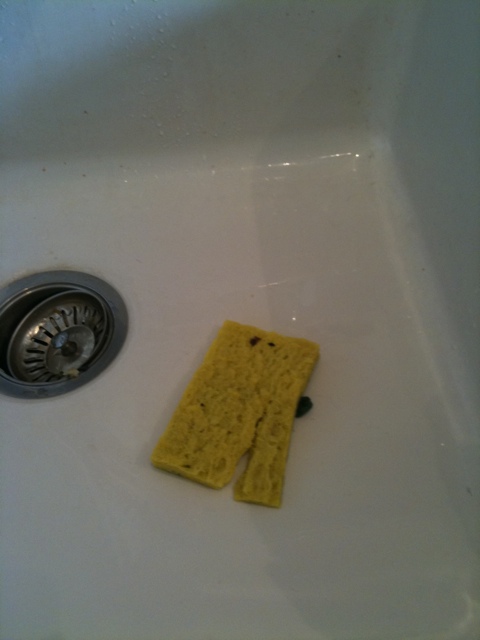
Since, here, we are kind of starting to drift off beyond the garden and into talking about trying to live responsibly, loosely speaking, I’ve been thinking lately about sponges. These aren’t real sponges but that’s what we pretend they are. And I know they’re filthy yet we pretend to “clean” our dishes with them. Here is the culprit, in the sink next to the dishwasher that rarely gets used because of my efforts, as I said, to try to live somewhat responsibly. That said, how responsible can it be to wash my dishes with a dirty sponge. Of course I rinse it out and squeeze it before using it each time but still I can almost feel the bacteria seeping through its pseudo-pores. My partner keeps a dish of soapy water next to the sink and uses that instead of wasting loads of water each time we need to clean dished. Even with that, I’m sure there’s bacteria that accumulates there as well. I used to put a drop of bleach in it to ward off the little bastards but now that I’m getting into the living somewhat responsibly, the thought of bleach, the plastic it comes in and all its nasty chemicals makes me shudder.
I’ve been on this earth, let’s just say, awhile now. And one of the things that continues to stump me is ….
QUESTION: what tis the best way to clean dishes (in a way that isn’t really just a foolhardy practice of moving germs around), without using nasty chemicals or wasting water? Also, does dish soap really do any dish or anyone else any good? Is a dish soap that’s marketed as an eco-friendly one either eco-friendly or effective? Go ahead (even though I’m sure there’s plenty already on my dishes) … Gimme the dirt!
What I’m Growing
It occurred to me I hadn’t shared with you what it is I actually put into the ground. So here goes, by category, only edibles:
TREES/BUSHES:
- peach tree
- cherry tree
- elderberry bushes (almost certain not dogwoods now)
- Meyer lemon tree (in a container)
VEGETABLES:
- tomatoes, four plant, purchased at a Saratoga Springs farmers’ market, all heirloom
- cucumbers, eight plants, don’t remember where I purchased these but I think it may have been Shannon’s
- pumpkins, from seeds, picked up at a restaurant in New Haven, CT, when we went to see my friend, Bill Demerit, who’s studying theater there. I planted these and they shot right up. I now have six plants (confirm). Unfortunately, these are more the jack-o-lantern variety, but I figure they will give some nice color to the garden late in the season.
- wild ginger, three plants, purchased from the farmers market in Saratoga Springs from a woman who was the only one with a plethora of native plants
- carrots, multiple. These are from seeds, which I didn’t really think would take off, since I’ve had difficulty growing carrots from seeds before but that was straight in the ground. These are growing in a wooden box (like an apple crate) that I used to have hops from Six-Point brewery growing in (ever want to check out some good looking hops, pay them a visit by going to Rocky Sullivan’s in Red Hook – on the upstairs terrace, they usually have hops growing there).
- beets, multiple. These are also from seeds and, again, I planted more than I need, thinking they might not come up for the same reason – I’ve tried planting them from seed in the ground before with no luck. In contrast, these little seeds [brand], which I put into the small plastic starter containers you get new plants in [name?] sprung right up. I now have the dilemma of where to make their seasonal home.
- jalapeno peppers. These I picked up in a set of three starter plants from Shannon’s. I had good luck with these plants last year and wanted to try it again. I have them in a different location (south-facing upstairs terrace) than my north-facing backyard where they were before. We’ll see if it matters. They are in a couple planters with some other hot peppers (another jalapeno and cayenne, I believe) that I tried to maintain indoors over the winter but I’m not sure they’re actually going to produce again since they’ve remained essentially unchanged from last fall when I brought them in.
- new addition: green beans (these seeds just went in the ground from my very most awesome neighbor friend, who is also growing green beans & sweet peas in a self-watering container)
HERBS:
- sage
- thyme (three types)
- rosemary (not doing so great)
- cilantro
- parsley
- mountain mint (got this from the Grand Army Plaza farmers market)
- (will be growing: basil from the Triscuit box seed card & dill from same)
QUESTION: what grows in your garden? Who’s happy this season? Who’s not?
The Green in New York

Financial district, 06/07/11 8: ish p.m.
I Love Gardens
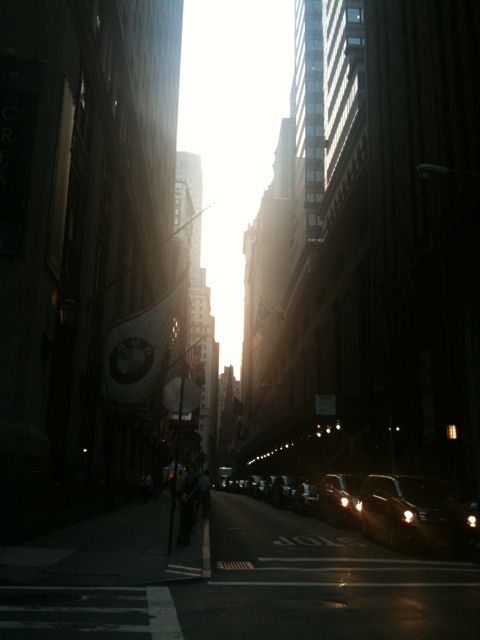
But I do so love you, New York
Glad to be Hunter-Gatherer
So the hunting is more about going to Foodtown to pick up some ribs for my partner to smoke (and are they good, and I mean damn good!) but the gathering part I’m also starting to really dig. Right now I’m borrowing from my very-most-awesome- neighbor-friend the book Edible and Medicinal Plants in Wild (and Not So Wild) Places, by “Wildman” Steve Brill with Evelyn Dean, 1994, and trying to not get the pages too covered with pricey dirt or, earlier today, the really good Sunday Bloody Mary my hunter made for us.
Notwithstanding, I believe I am starting to get closer to the question of whether my three bushes out back (I think I described them incorrectly before as a single bush) are dogwoods or elderberry. Knowing as you do now that there are three, not one, you can see why this question is ever so pressing, as Brooklyn garden space is premium real estate and I don’t want to waste it with something that might poison the kiddies who frequent the place, or my dog for that matter, nor am I sure I want to leave it if it isn’t behaving usefully, like giving me some tasty berries to make wine or jam, or hiding in its bark the secret cure for hay fever. Sure, I am getting sold on the idea that native plants are good to have around in their own right and for the simple sake that they are part of an ecosystem that’s been messed with for too long but I’m still not 100% convinced on that matter. Regardless, I like the thought of eating the stuff in my yard.
It must be on other people’s minds, too, because I found myself in my backyard Saturday in a group of people, all nibbling on these cute delicate little creatures with soft tangy leaves like clover, all trying to remember the name of this same thing that we knew from when we were kids. Someone suggested ramps (which was way off as it turns out – I know because a good-old fashioned real-live farmer showed up later and went into how they found ramps behind their property in a swampy wasteland but now folks are flocking for them). Ultimately, we grabbed the book (thanks neighbor!), and found that they were sorrels. Yummy ones, too!
I’m definitely interested in eating more stuff in my yard and maybe your yard too. But before I do, I think it would be responsible of me to get a little more educated on the subject. Toward that end, I’m thinking about taking a tour with author and forager, “Wildman” Steve Brill, author of the book I’ve been devouring (not literally). There’s one at Central Park on the 11th and another in our conveniently located Prospect Park on June 18. Just wondering….
QUESTION: Has any one of you taken a tour with Wildman Steve Brill? Would you recommend it? Do you know other people doing these sorts of tours? Any of you brushing off your gathering skills (it must still be in our DNA somewhere), and foraging for your own fare? Any words of caution? Words of wisdom? Any stories of watching someone keel over after eating what looked like an elderberry but was really from a weird strain of dogwood? Any anything? Go ahead … gimme the dirt.
SCREEEEEECH! STOP THE PRESS!!! Okay, so I thought it would be nice of me to link y’all to sorrels on Wikipedia and when I did, I saw that they do not AT ALL match the description of what friends and I were dining on in my backyard Saturday. Someone help me out before I kill us all … I will post a pic tomorrow in daylight and let me know if any of you recognizes it. In the meantime, for those wanting to know what real sorrels look like, here ya go (then again it is Wikipedia, could be wrong? Maybe? http://en.wikipedia.org/wiki/Sorrel). I also couldn’t find sorels in my handy dandy Edible Plants book, which leads me to another …
UPDATE as of 8/10/11: they were wood sorrels. Wikipee was showing me a different type of sorrel.
QUESTION: Does anyone out there have any other recommended sources for checking out edibility of wild plants? Anything more recent, anything forthcoming? Go ahead … gimme the dirt on this one too. Oh, and thanks!

