Alternasourcing and Getting Back to the Garden

Hello fellow revelers,

I’ve been taking my time getting back up to speed on things in my garden and life since a much needed hiatus that involved throwing myself in heart, mind and soul in a writers’ workshop in the wilds of Vermont, with one phenomenal group of compadres, led by the magnanimous Crescent Dragonwagon, cookbook author extraordinaire (as well as children’s book author, poet, instructor, all around phenom, and etc.).

A rapid fire survey of the grounds this morning reminded me that a garden needs tending well past the browning of the last cuke on the vine.  I’m not much of a fall gardener, but I still have the steadies going: my hot peppers upstairs, the various herbs, the last of my heirloom tomatoes, and that mysterious bush out back that I never did determine conclusively was dogwood or elderberry (the issue became less pressing when the local herbivores devoured the few fruit it produced this year).  The pumpkins that I got after a friend’s show at a restaurant in New Haven last year gave the scene bountiful color with its vibrant squash blossoms springing from every vine wound relentlessly up, down, over and under every spare inch in my yard.  Alas, I don’t think they’re going to give me a single jack-o-lantern by Halloween.  My neighbor from Bangladesh watched as I cut back the wild rose bush that likes to keep sticking its neck over into her territory where her kids like to play.  As we were talking, she saw me cut off one of the many pumpkin stems squirreling around the yard.  She asked me why I cut it, since it had a small blossom that looked ready to bloom.  I didn’t really know.  I guess it was because we were in conversation, and as I said before, I don’t really like to talk as I’m gardening.  It’s not the kind of multi-tasking that makes me feel like I’m accomplishing something.  If anything, when I’m persuaded to talk while I’m gardening it robs me of that little bit of time I get away from the rest of the world.  But this is a good neighbor, and I like her company, so I didn’t mind much this morning.  But the point is that the talk made me absent-minded, and I plucked a perfectly good vine I likely wouldn’t have otherwise.  She asked me for it, and said she’d like to cook it.  I thought she meant the squash blossoms but she was talking about the leaves.  I remembered a few years ago she gave me a plate of food she had made for Ramadan, and it had fish cooked with leaves from the squash she had growing out back.  It was tasty and I’d meant to ask for the recipe then, but never did.  This morning, after a few more minutes commiserating over a sad season for fruit trees (she has plum, peach, apple, and cherry in the back to my peach and cherry), she decided she wasn’t going to have time to cook today and handed me back my needlessly interrupted vine.  I tossed it in with the other clippings to be put to the compost out back.  We agreed that in the next couple weeks, we’ll make a day of picking and cooking the leaves that are now so overly abundant in the yard.

Something I heard several times last weekend at the workshop/retreat was one of Crescent’s sayings, inherited, I believe, from her father, Maurice Zolotow: “nothing is wasted on the writer.”  The same, it seems, is true of the gardener.

As I mentioned before, the extent of tending my front yard last year was to toss whatever seeds I had aging in my basement to see if any would take root.  As you likely know by now, my approach this year is slightly more steady, measured, and, hopefully, responsible, since that is a goal I’ve set for myself.  I am moving toward living a more responsible life overall, one where little to nothing is wasted.  Toward that end, I am supplanting my gardening with the exploration of additional paths to self-sufficiency since self-sufficiency is, in and of itself, responsible.  Of course we don’t all have the means to “Thoreau” it all away and Walden our days away.  For those of us who are revelers of the brick and mortar set (though not limited to this demographic), I am exploring, in various arenas, a practice I have coined “alternasourcing.”  As I use the term (and invite others to collude), alternasourcing is the obtaining of goods and services from non-traditional sources, which, in its optimal functioning, provide sometimes less expensive and frequently more environmentally and socially friendly products.  Alternasourcing is not just about where you get your goods.  It is also about the how you obtain the things you need to live (as well as the things you want, hopefully with an eye to questioning needs/wants in a new way).

Alternasourcing may include, for example, minimizing the groceries you buy from the corner megastore, and supplanting it with regular visits to your local farmers’ markets, using your own space for herbs or whatever you have space for, learning how to forage for naturally grown wild edibles, or getting a plot in a community garden.  (An aside: my uber-awesome neighbor/friend/co-gardener I mention frequently, and her partner, were on a three-year wait list in our not-super-hip ‘hood just to get a small triangular not-so-enviable plot in the local community garden.)   So, while you’re waiting in line for a patch of dirt down the street, consider new ways to tick those items off your grocery list.  It may include participation in a CSA, a venture I undertook this summer for the first time.  For those of you who have been following, the journey has had its ups and downs, but summer’s not over, nor are the remainder of my bi-weekly shares.  I’ve been chronicling it here, but thought it was time to bring in another voice (of reason, I believe) who has had a more hands-on CSA experience, and whose insight has helped answer nagging questions I’m left with after bagging up my produce (at that same community garden, btw).  Long after I’ve bagged up my goodies and have unloaded them on my table to shoot, the questions linger.  They usually concern the demeanor of the volunteers (disabusing me of the Pollyannaish notion that all gardeners are revelers).   For the answer to this, and an inside peek at what goes on behind the other side of the table….read on my friends in the next post, for a spiffy piece comped by our friend, former neighbor and fellow reveler, Matthew Donoher, who, btw, I ran into on Church Ave. right before Irene hit, as I was vying with the other stragglers to get the last of the should-have-had-a-long-time-ago items, such as flashlights and batteries and radios.  Matthew, to his credit, was cool as a cucumber, in search merely of a new baking sheet to try out an oatmeal cookie recipe.  I have been blessed in my life with good neighbors.

How about you?  What are ways that your life has changed in response to global climate changes, or economic turbulence, or just your own desire to live more efficiently/responsibly?

Go ahead… gimme the dirt!
I Never Promised You a Rose Garden

I have mixed feelings on the rose bush in a container on the top of my stairs on my front porch, the plant that is closest to my front door.  The concern may be that I am so concerned about it.  I have tended, preened and pruned to plants that I am working to produce something to put on my kitchen table.  I have never, however, been one for fussing over a flower.  Don’t get me wrong.  I appreciate them as much as the day is long.  I think they are one of God’s most intense, delicate and magnificent creations [I think most folks would agree, having the freedom to enter their higher power of choice, of course].  But I’m not sure how I feel fussing over them.  But fuss I do, and probably not as much as I should.  I really am very proud when I see a bright pink rose bud burst into full bloom right there in front of my doorstep, as if to shout a message like one of those you might see on a 1970s tee – Someone in Cheyenne loves me.  “A green thumb in Brooklyn loves me!”  Maybe it trips me up a bit because I am reminded of the Type A rosebush fusser in that really cool movie with Kevin Spacey where he lusts after his kid’s friend and she’s got the rose petals falling up all around her nakedish body.  What a crude juxtaposition…wifey with the rosebud clippers snipping manically away while he makes his life liveable being creepy.  Ah, I may not be remembering it perfectly well but there may be some association (think rosebush competitions) between rose growers and gardeners who get their rocks off manipulating God’s (or Whoever’s) roses into humble submission.  It doesn’t stop me from being duly impressed by one who lords him or herself over the seemingly untameable force that is the Rosacae, clippers held high victoriously high above the lowly but wild and free Eudicot (yes, I wiki’ed that one).  But now, muah ha ha, eep!  I’m one of them.  Maybe not, though.  I can’t say I’m successful enough to count myself in the class of clipper wielding rose obsessed gardeners.  But I’m getting there.

That said, the QUESTION that came to me today is how to use coffee grounds in your roses, or if it’s better to put the grounds in the compost.  ANSWER to follow…

Stirred Not Shaken

I should have known I was on shaky ground when I took my usual position on the 9th St. platform this morning — right at the spot that spits me out in front of the turnstile on my stop — and in permanent marker on the post nearest me was a brutally racist remark scrawled in hatred and large enough to read standing several feet away.  I was puzzled.  Maybe I have been naive in believing that level of ignorance was nearly extinct, especially in this great metropolis.  It seemed like the work of an adult.  I tried to imagine him.  It was a him in my imagining.  Unemployed, underemployed.  Poisoned with hatred, but why?  I almost took a picture, thought about drawing attention to the fact that racism is not dead but is alive and … not well.  I decided not to give it more attention than it might already be garnering.  I would not engage in sowing revulsion.  The image in my mind of the handwriting gnawed at me as I tried to reverse the course my day had started.

At work, I comforted myself by settling into my routine after grabbing coffee, yogurt, and trail mix in our building’s basement cafeteria.  I was running late from the time I got up and didn’t have my usual breakfast of oatmeal and coffee at home.  My next-door-office neighbor, friend and colleague came into my office to discuss a matter he was working on.  I complimented him on his snazzy running shoes (he’s a pretty serious marathoner and nutritionist in his free time).  I noted I should keep a pair of sneakers in the office.  We started in to working on the matter at hand, and called a supervisor at another branch to help solve the issue and, as the three of us were on speakerphone in my office, and I was just beginning to feel like the day might be getting back to normal, I spotted a very small bug on my desk, coming straight for me.  “Oh, fuck,” I whispered.  I have worked in this building for four years, and have sat on five different floors in that time.  Moving from floor to floor, you get to know people.  You hear things.  One of those was of a rumored bedbug infestation on another floor.  I smashed the bug, still alive, in my coffee napkin and took it to property management in the basement.  Phyllis looked up at me, raised her eyebrows nearly to the locks above her head and said straightaway, “that’s a bedbug.”  We handled the thing like it was an explosive device.  After I turned it over to her, she smooshed the life out of it, placed a piece of tape over it and began to solicit more seasoned opinions.  After I went through twenty minutes of controlled freak-out, our resident expert inspected the creature and informed us all it was not, in fact, a bed bug.  He produced a bedbug in a baggie for me to compare.  Indeed, mine was not a bedbug.  I went back to my office feeling certain the day could only get better from there.

But we know what happened next.  I have never been in an earthquake before, so to me it felt more like standing on the grates above an active subway station in a windstorm, times 10.  I was talking to a coworker on the phone when the ripples ran through lower Manhattan.  I needed no further warning.  I sprang from my desk, grabbed my bag, and when I realized I didn’t know where the stairs were (what was I doing during all those fire drills?), I took the elevator down the seven stories to ground level, half-apologizing to my colleagues for not sticking around (to watch the building come down), explaining that I watched the first tower come down on 9/11, and I know better than to wait around.  We got down pretty quickly but the street was already filling up with suits, tourists, vendors, workers, all trying to overhear other conversations about what who had felt and what who had heard.  I collected some quick news from my partner whose office is in midtown, one text and a quick call then the cell service was down.  In midtown they had seen the lights shake.  Thanks to my partner, I knew it was an earthquake (not a bomb, as some had thought).  I tried to get away from the tallest buildings, and planted myself near the Trinity Church cemetery.  A cluster of people were exchanging what they had heard: Maryland had been hit; the epicenter was in DC; Brooklyn shook bad; someone in Jersey had felt it.  I threw in my two cents about lights shaking in midtown.  Soon I had enough of a picture to make the decision to head back to Brooklyn.  It was the middle of the day.  I had been Sametimed by my boss for help on an assignment.  This is just one of two days I work in the office.  I knew it was risky to leave without checking.  But I’ve seen people jump from buildings.  I headed for the R and hightailed it for terra firma.

People waiting for the train on the platform didn’t know what had happened.  They hadn’t felt the tremors.  Some said they saw people pouring out of buildings.  Another said they heard firetrucks, but hadn’t felt anything.  I tried to spread whatever news I had.  I told the Asian man in the business suit and his girlfriend in the too-tight dress what I had felt, and asked if they felt anything.  They stared at me with wide eyes, obviously trying to figure out if I was a lunatic.  I smelled alcohol on their breath, and moved on to the next group.  A family visiting from Michigan, the mother obviously trying to figure out how serious this was without out and out asking me in front of her two children, probably 7-10 years old.  I stood with them for awhile, talking midwest nice and trying to get cell service.  I knew I wouldn’t be able to but something makes you try the impossible in situations like this, where you don’t know what really just happened and what lies ahead.  The towheaded little boy innocently suggested I use the payphone on the wall, an idea that struck me as genius until I remembered how rare it is to find a functioning pay phone in New York.  Again, trying the impossible, I picked it up hoping to get a dial tone but instead my ear was pricked by the loose wires where the earpiece used to be.  Eventually, an elderly MTA worker came along and I prodded him to find out what was going on.  He shuffled down to a red service phone that he pointed out should be used in an emergency.  A few minutes later, he returned triumphant, his dark eyes lighting up beneath his broad forehead that was now glistening with beads of sweat.  “TRAINS ARE RUNNING,” he bellowed with pride.  The train came along as if on cue.  Before the family from Michigan got off at the next stop, I handed them my card – sometimes you have to rely on the kindness of strangers.  After Whitehall, in the long passage between Manhattan and Brooklyn, I listed to two girls talking rapidly to each other in Spanish.  Although I couldn’t catch everything, I understood that one was afraid this was the end of the world.  The other was teasing her but obviously ill at ease.  I struck up a conversation with them, and found out then that the earthquake had happened in Virginia.  The girls had been leaving work, ground level, and hadn’t felt anything.  One was able to reach her aunt in Sunset Park who told her some of the details.  The younger one still seemed nervous this was the end of the world.  I told her with confidence that it certainly was not, and that the end of the world would come with much more fanfare – something extravagant like horses with wings and the Pope on fire.  By the time they got off the train, they were giggling and we all were wishing each other well.  The man next to me overheard our conversation, and asked what was going on.  He was on his way to work at the Bureau of Prisons in Brooklyn.  At his apartment in the city, he said he felt his bed shake but thought it was just his wife trying to wake him up for work.  But she had been in the other room.  I gave him what I had gathered from the time I left my office until then, including what others had experienced.

Everyone, it seems, felt something different.  My colleagues on the 11th floor, I later learned, barely felt it.  On 7, we all stopped and didn’t hesitate to flee our offices, the tremor was so strong.   A friend in another building that faces the back of the stock exchange later told me she saw people running out of it.  The folks  I saw underground were either trying to appear nonchalant, or were busy reading other people’s faces to see whether anything more had happened.  In this way, it reminded me of how people were when I worked downtown Manhattan in the weeks following 9/11, or what the sojourn from Manhattan to Brooklyn was like in the blackout of ’03, or the faces of my own neighbors this summer, in the days after Leiby Kletzky was killed.  This is the way a city communicates.  We gather bits and pieces from strangers as much as the people we know.  We rely on each other.  We count on each other.  We exchange odd little nuggets of data and knowledge to put together an incomplete picture, but one that will satisfy us until we have the energy to mine for more.

In telling the prison guard what I had learned, I missed my transfer to 9th Street.  He was getting off at the next stop but told me to wait two stops till I could cross over without having to pay another fare.  I did.  It left me a bit disoriented, and I stood on the platform for a long time before realizing the trains were not going in the direction I wanted them to.  I asked an elderly Chinese woman for help.  She explained that I had to go to the other side and take it back a few stops to catch the F.  There was kindness in her eyes.

Since I now was transferring in a different direction than usual, I didn’t pass the post on the platform where I stood this morning, reading hatred.  When I got to the transfer, I rushed up the stairs, eager to see daylight.  The train was largely empty, a good sign.  There was no apparent nervousness or searching of faces, an even better sign.  Above ground, I stopped at the corner bodega where I heard the earthquake was in DC.  I talked to three different people on the phone in the block and a half walk from the subway station to my door.  Before I reached my house, I found I also had a voice mail from a friend in Indiana. and a text from another in Harlem.  Everyone just checking to make sure everyone is okay.  Once home, relieved and exhausted, I powered up the computer, logged in at work, and took a quick check on NPR to see if there was any news.

There was.  Today, August 23, 2011, a memorial to Rev. Martin Luther King Jr. was opened to the public at the National Mall in Washington DC.  The statue is inspired by Dr. King’s “lifelong dedication to the idea of achieving human dignity through global relationships of well being [that] has served to instill a broader and deeper sense of duty within each of us— a duty to be both responsible citizens and conscientious stewards of freedom and democracy.”  (www.mlkmemorial.org).  The “Stone of Hope,” a 30-foot sculpture, which took almost five years to build, faced countless obstacles and challenges to its being there.  The brainchild of members of Alpha Phi Alpha, the fraternity to which Rev. King belonged, the statue that began as an idea in 1984 took President Clinton proposing its construction, joint resolutions by Congress for its establishment, a design competition that generated controversy, and fundraising more than $100 million to build it.

But build it we did.

I Got Globally Warmed

And I am not alone.

Victims (not quite casualties but close): hostas and carrots and maybe the cukes too but the latter did produce. They just slowed down during and after the wicked heatwave we had.

So I made it to The Big Easy. But my troubles are not all at an end, my friend. I don’t like what I’m hearing. I met a gardener from Oklahoma who said they’ve been without rain for about two months. Said she went away for two days and came back to find her petunias and other flowers all wilted or dead. Another friend outside Chicago put as her Facebook status that someone had murdered her cilantro (I think that same killer was on the loose in my herb garden). When I was talking to a fellow reveler in Carmel, IN a couple weeks ago, she had to stop mid-sentence because it started to rain, something they hadn’t seen in many weeks (may also have been a couple months). She and her father commented that a lot of people would be stating out their windows at that moment. All other folks, too, across the country have been telling me their global warming woes. Hope about you?

QUESTION: what’s your take on this wacky weather? Are we getting globally warmed? What does your garden have to say about it? Are you changing your approach in response? Will this change what you do next year? How so?

Go ahead … Gimme the dirt!

I Had Trouble in Getting to Big Easy

The day started out rotten.  Up at 4 a.m. (okay, well 4:30), only to miss my flight to New Orleans, despite my best efforts.  Made it all the way to JFK, raced inside like a lunatic, wheeled luggage flying behind me, only to find out I’d have to pay an additional $80 for the next flight this afternoon, couldn’t check my bags until at least after 1:00, and would have to trek it back home in the meantime to wait (which meant another $100 in cab fare to get home and back again later).  Sooooooo, while still in a spectacularly foul mood, I headed out back to check on the garden.

I had major renovations done on my house in the last six months.  I find that when I’m in a good mood I look at the changes and am pleased as punch I laid out the money for it.  When I’m grumpy, I see the tiniest nicks and chips in the new paint or corner spots where the moulding isn’t perfectly straight, or that infuriating little dribble of paint that hardened under the counter ledge in the opening between the dining room and kitchen, and think about the dollars wasted.  This morning I found the same phenomenon occurs in the garden.  I went out there and all I saw were the problems.  Although the first heirloom tomato ripened, this morning all I could see was the split at the top.  While the peach tree is producing lots of fruit despite some early season troubles, all I saw this morning were problems that I don’t remember being there a few days ago.  (In May, I sprayed it with copper fungicide but not in the amount Shannon’s recommended — I try to go easy with that stuff even thought it’s organic.  It’s still copper being sprayed on a tree that produces fruit I fully intend to eat.)

So, although I didn’t skip through the garden this morning, peppering self-congratulations, I did identify some problems that need fixing.  Of course, my mood is a little improved after getting up close and personal with the plants; that never fails.  Eternal happiness and sprightliness, however, can be a dangerous thing.  I don’t know that I would have spotted those issues if I weren’t such a grumpy gardener this morning.

I do feel like the guy in Dr. Seuss’ I Had Trouble In Getting to Solla Sollew.  He left all the pesky troubles he was having at home to get to the beautiful city of Solla Sollew (on the banks oft he beautiful River Wah-hoo, where they never have troubles, at least very few), but found that the journey wasn’t quite as easy as he had expected.  After an exhausting bout of difficulties getting to SS, he arrives to find that the city is suffering from a key-slapping slippard who moved into the door, and now no one can get in and no one can get out.  The town’s gone to pot and even the ever loyal doorman has decided to leave, off to the City of Boola Boo Ball, where they never have troubles, no troubles at all.  So, while I’d really like to kick off this vacation with a bloody mary, fixins courtesy of the garden, and chill till my flight at 3, I’ve decided to follow dude’s suggestions.

Declining the doorman’s invitation to follow him off to paradise, he tells us what he has decided to do:

…I started back home, to the Valey of Vung.  I know I’ll have troubles.  I’ll, maybe, get stung.  I’ll always have troubles.  I’ll, maybe, get bit by that green-headed Quail on the place where I sit.  But I’ve bought a big bat.  I’m all ready, you see.  Now my troubles are going to have troubles with me!

Watch out ants.  I’m going to Shannon’s to buy my big bat.

Before

20110723-114752.jpg

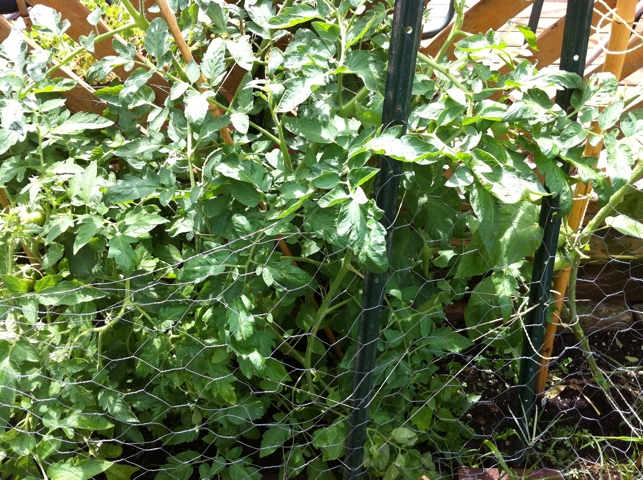
This is the “before” shot of one of my tomato plants before I decided to trim it.  Just to the right, you can see an “after” of the brandywine, which I did chop down quite a bit, in honesty, more than I intended.  (It has a very bent stem due to late staking — horrifying, I know.  But plants are hearty beasts and it’s still giving me hearty fruit .)  So I did this pruning one day before sitting next to an experienced gardener who lives down the street.  Her sons come to visit two weeks every summer, and the whole nabe ends up there for a beer or two at some point in those two weeks.  Her front yard is gorgeously adorned in always bountiful flowers and I’ve heard of the abundant veggies and other fruits and foliage she grows out back.   In her heavy Italian accent, she told me, “nooooo, you don’t do dat” when I showed her the before and after pictures of the tomatoes I had cut back the day before.  My pruning adventure also occurred one day prior to talking to my friend whose family works 20 acres for local markets in Indiana.  In addition to other interesting tidbits about tomatoes (including that the sweetest part is the bottom because the sugar sinks and settles there), she also admonished me (in the friendliest way — she is a Hoosier after all and therefore born into midwestern nice) for my pruning efforts.  It was one day before listening to a couple podcasts on tomatoes, where none covered pruning with enough attention for me to think anyone else was doing this.  So I thought I was sunk.  My before and after should have stayed at “before.”  But, then, ta da!  The tomato plants seemed to love it.  They grew back some branches but wasn’t overrun with them.  And my eyes may have been deceiving me but suddenly tomato fruit were springing up where none had been before.

Now, having had some additional time to read a little further on the question whether to prune tomato plants, and realizing that the answers are more elegant (is it just me or is that word creeping up everywhere lately – throwing it in to be a member of the bandwagon) than I expected.

Having had time to consider all this – the instinct to prune, the tsking of my fellow gardeners, and the happy tomatoes as an end result, I affirmed what I have been discovering all along: it’s good to take in the advice you can get, but your own instinct and experience is your best guide.

Let’s Face It – Part II

A few days ago, I posted the following: More people are gardening because they think the world (as we know it) is going to end soon.

QUESTION: What do you think?  Go ahead … gimme the dirt.

And here’s some of the dirt…

Weighing in on FB:

Dwain Cromwell Not ending, but the world is changing. For the first time in my life, tomato plants are not producing in NW Arkansas because the temps don’t drop low enough at night for the buds to set. There are tomatoes at Farmers Market, but the vendors must have controlled set-ups. Back yard tomatoes just aren’t happening, no matter how much watering and care. It’s just so damned hot.

and

Crescent Dragonwagon ‎at Dwain Cromwell, this is SO sad. They say if climate change is not reversed, there will not be maply syruping in Vermont in 25 years.